
A fan watches their football team lose for ten months, through rain and heartbreak and the bottom half of the table, and then renews the season ticket in May, quite happily. That same person has shopped at the same supermarket for years, but when their coffee goes up by fifty pence they are across the road by the weekend, loyalty card forgotten.
We tend to read that as a contradiction, though I don’t think it is one. As a customer, they are doing very sensible arithmetic about what they get and what it costs them. As a fan, they are doing something else altogether, because that relationship runs on identity rather than on value, and when the team fails, the shared misery deepens the belonging rather than eroding it. The brand is swappable, but the tribe, never.
The distinction, and the uncomfortable part
Reysen and Branscombe (2010) drew a line between two things we usually lump together.
Fanship is your attachment to the thing itself – the club, the game, the product. It is why you buy the shirt and queue for the launch.
Fandom is your bond with the other people who love it: the group chat, the away day, the in-jokes.
They measure separately, and they behave quite differently.
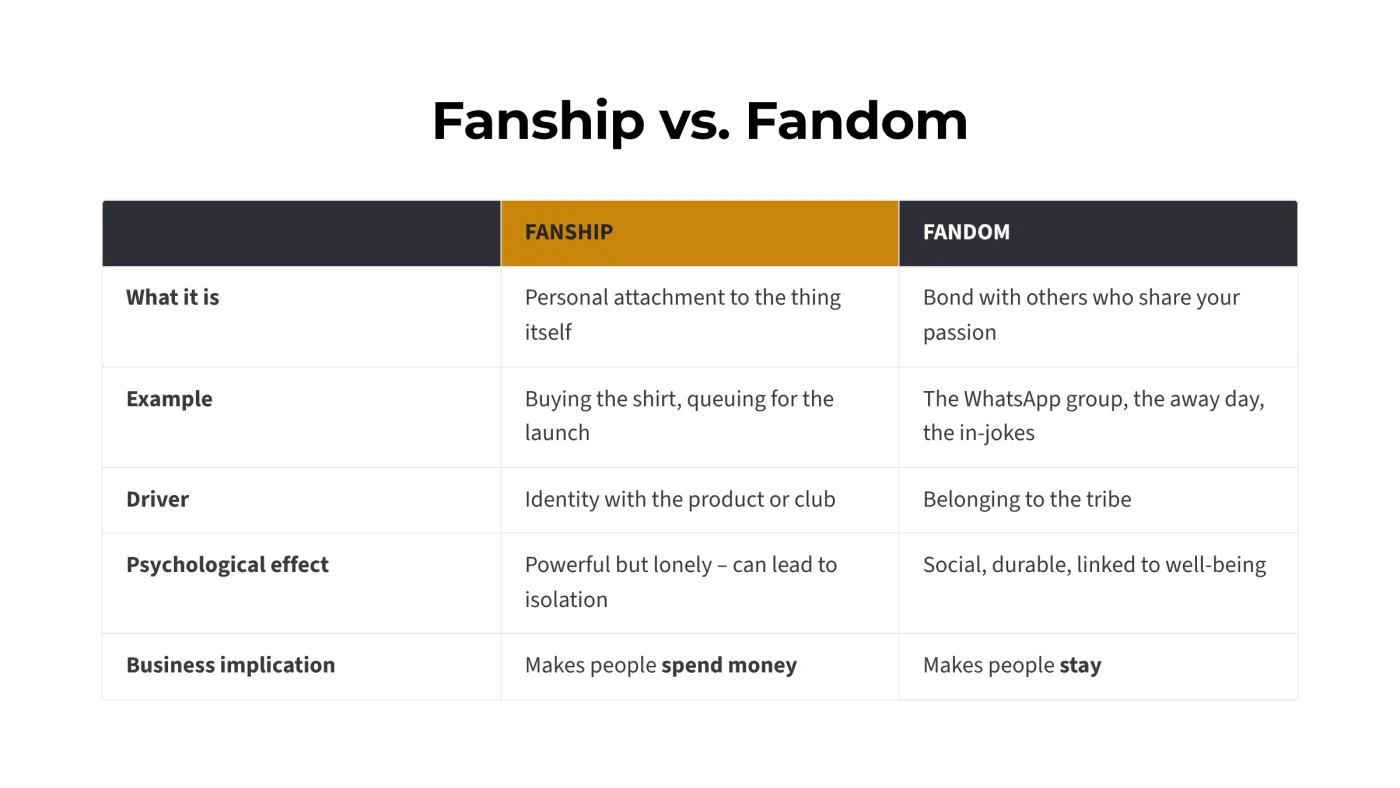
The uncomfortable part, for anyone building a product, is that fanship is the half that spends and it is also the half that is lonely. More recent work associates isolated fanship with problematic purchasing and social withdrawal rather than with wellbeing, while fandom is the half that lasts and the half that carries the psychological benefits.
Which leaves us with a slightly awkward arrangement: the half that monetises is not the half that sustains, and the half that sustains is the half nobody has worked out how to manufacture.
What loyalty programmes actually buy
I want to be fair here, because loyalty programmes get written about as though they don’t work, and the evidence says otherwise.
Around ninety per cent of programme owners report a positive return, with an average of 4.8x. Members generate somewhere between 12% and 18% more incremental revenue a year than non-members; the best-performing programmes lift revenue from participating customers by 15% to 25%; and roughly 73% of consumers say they adjust how much they spend to make the most of the benefits on offer.
That last figure is the one I keep coming back to. People are telling us plainly that the mechanism works, and that they will reorganise their spending around it.
So when a company launches a scheme, they are not being foolish. They are responding to real numbers.
The difficulty is what those numbers are counting. Every one of them is a transaction metric – spend, revenue, repeat purchase, return on investment – and each one confirms that a well-built programme moves money. None of them tells us anything about whether the person feels differently about the brand at the end of it.
And when you look for that, the picture changes. 75% of customers say they will leave a programme for a better price elsewhere. Around 30% of brands rate their own programme as no better than somewhat effective.
Both sets of findings are true at once, and I don’t think there is any tension between them. Loyalty programmes are very good at shifting behaviour and not at all good at creating attachment. The trouble only starts when we mistake the first for the second.
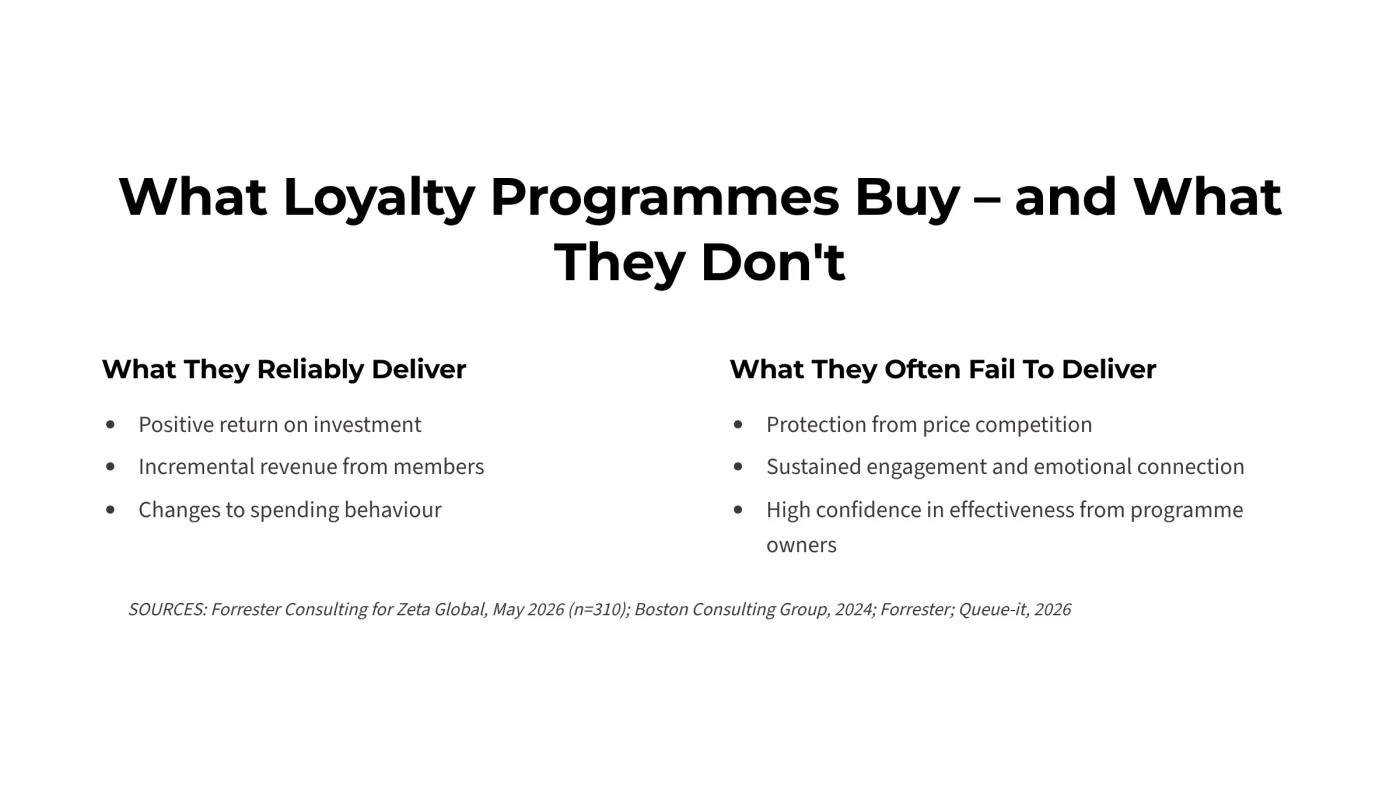
A note on those numbers, since it matters. Almost all of them come from vendors and consultancies with something to sell, and the ROI figure in particular is programme owners marking their own homework. I have used them because they are what the industry has, but I would not lean on any of them too hard, and neither should anyone quoting them back at me.
Gamification: where it goes wrong
The failure mode is not the mechanism. It is pointing the mechanism at the wrong thing.
Points, badges and leaderboards reliably produce the behaviour they measure. Users farm badges, climb tables and post thin contributions, because that is what the system asks for and people are obliging. Whether that behaviour is the one you wanted is a separate question, and it is the one most programmes never get round to asking. A rising engagement graph is not by itself evidence that anything underneath it is working.
Underneath that sits the overjustification effect. If you reward someone for something they were already doing out of interest, you reframe it as work, and when the reward is withdrawn the motivation does not return to where it started but settles somewhere below it. This is why the same mechanic that works beautifully on a purchase can do real damage when you attach it to contribution, creativity or community participation – the behaviours people were doing for their own reasons before you arrived.
Systematic reviews keep surfacing the same three problems when gamification is applied to intrinsically motivated activity:
- Reduced intrinsic motivation, as attention moves from the activity to the reward.
- Maladaptive goal orientation, where the objective shifts from doing the thing to winning the game around it.
- Limited transferability, where the behaviour rarely survives outside the system that paid for it.
This is what I do for a living – retention audits, behavioural journeys, motivation design – and the pattern I see is very rarely a design flaw. It is a mechanic borrowed from the transaction layer and pointed at something that was never transactional.
How to actually host
You cannot manufacture identity fusion, that sense of oneness people describe about a team or a band. What you can do is build the conditions in which those bonds form on their own, and then step back far enough to let them.
Self-Determination Theory names the conditions as autonomy, competence and relatedness.
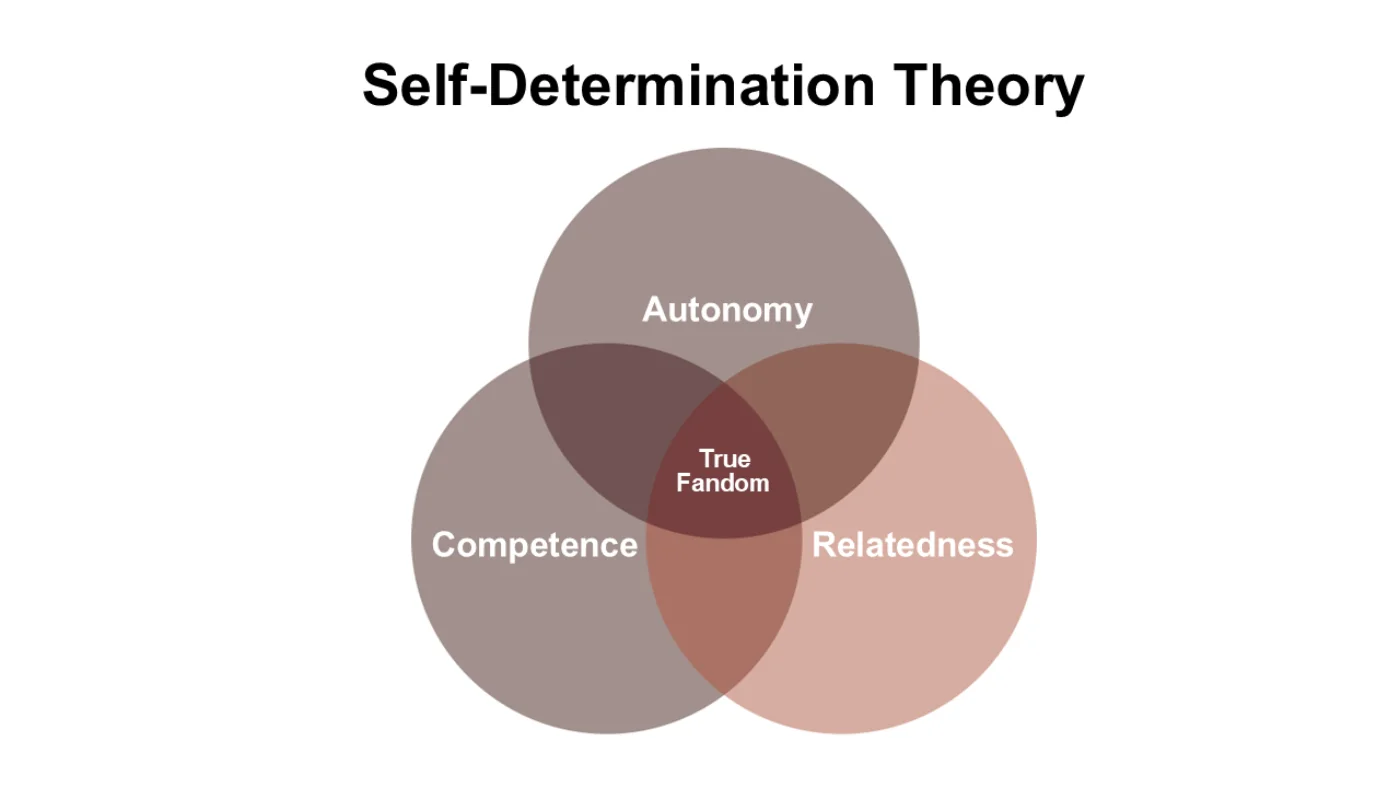
Which turns the design question around. The useful question is not how to make people love us more, but how to make it easier for them to find each other.
Here’s how:
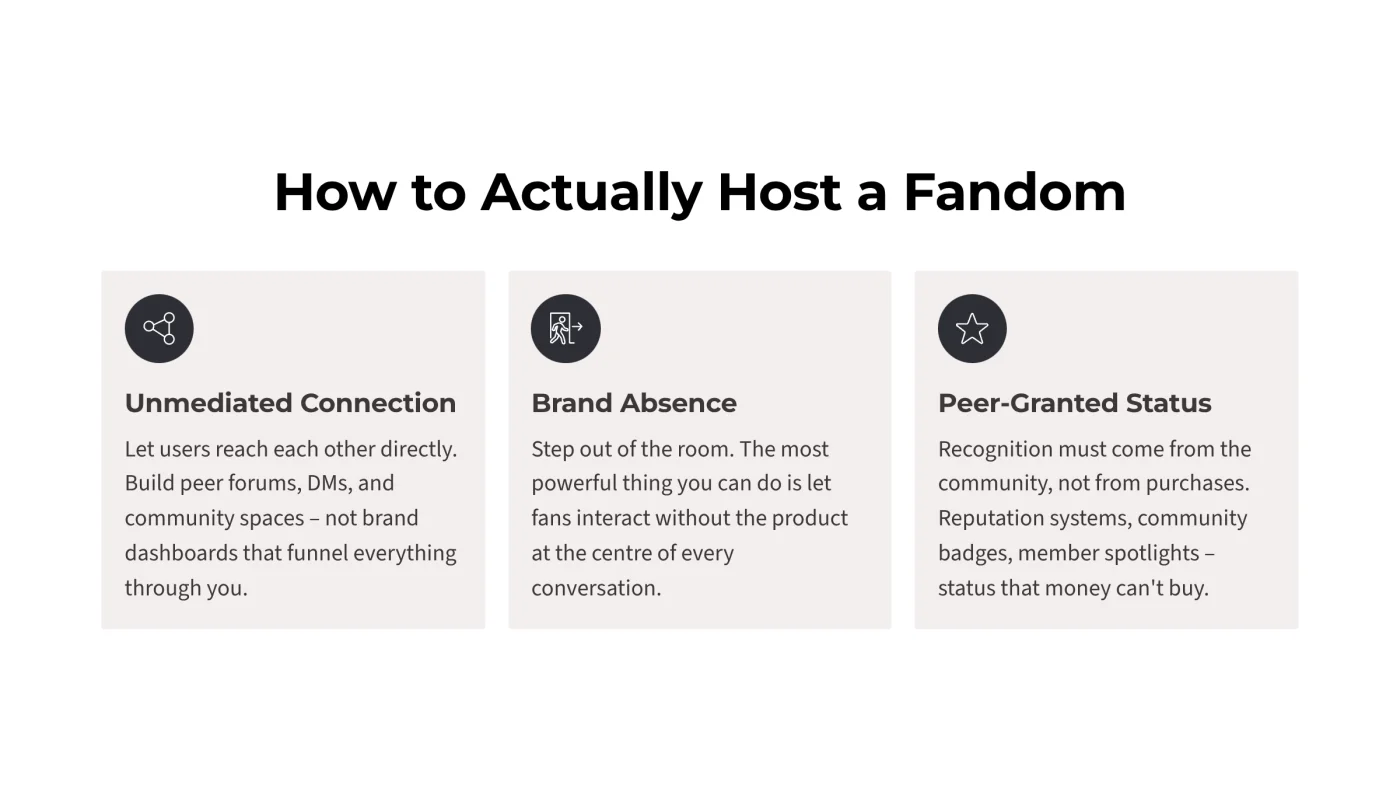
- Make it simple for users to connect, without forcing every interaction through your branded dashboard.
- Let fans interact without needing the product at the centre. Sometimes, the most powerful advocacy happens when you’re not in the room.
- Build systems where recognition comes from the community, not just from purchases.
There is a fourth shift that gets less attention, and it is where personality psychology comes in.
A community does not have one door. Openness to Experience, one of the Big Five personality traits, predicts an appetite for the immersive end of things – lore, creation, depth, the people who read everything – while Extraversion predicts the social end, the events and meet-ups and visible contribution. If you build a single route in, you select for one personality type and then describe everybody else as disengaged.
Games have understood this for a long time, because the same title has to work for the player who reads every codex entry and the player who only turns up for raid night, and the ones who quietly drift away are usually the ones the game never found a role for. Most non-game products still build one path, and then wonder why the community is so much smaller than the user base.
The caveat, and the rule
We study the winners. FC Barcelona, BTS, the outliers whose community management looks like genius in hindsight. For every one of them there are thousands who ran a comparable playbook and disappeared, and nobody writes those up.
Survivorship bias runs through this whole literature, and I should be honest that it runs through the shifts above as well, since they are drawn from what worked for the ones we can still see.
What I would defend with more confidence is the negative claim, because we have much better evidence about what suppresses a bond than about what creates one. Most products suppress it by accident: routing every interaction through a branded surface, metering the social behaviour, handing out status according to spend.
So use the mechanics. They work, and the numbers are real. Just be careful what you point them at.
Reward the transaction, never the devotion.